
For patients with suspected rare genetic diseases, finding a diagnosis can take years, and a negative test is not always the end of the search. Doctors may order genetic testing to look for changes in a patient’s DNA that could explain their symptoms. A diagnosis can guide treatment, monitoring and decisions about future care.
The test sequences part or all of the patient’s DNA, identifies the genetic differences, and compares them with what scientists know about disease. But the investigation doesn’t always produce an answer. A genetic change can be found without enough evidence to explain its significance, or the original analysis can miss something entirely.
Genomic reanalysis goes back to the original sequencing data instead of repeating the test. Specialists examine it again using updated scientific knowledge, improved analytical methods or new information about the patient’s symptoms. Across 29 studies involving 9,419 previously undiagnosed patients, reanalysis produced additional diagnoses in approximately 10% of cases.
The original sequencing data may not have changed. What changed was our ability to interpret it. That matters for anyone setting expectations for how long data stays useful, since the data doesn’t need to change for our ability to extract value from it to improve. This post follows one rare-disease use case to show how.
Genomic reanalysis and new answers
The path from a blood sample to a diagnosis has four steps.
- Read the DNA. A sequencing machine reads the patient’s DNA, usually as millions of short fragments, and turns it into digital data, called reads.
- Reconstruct and compare. Software lines the reads up against a reference human genome, a standard human DNA sequence, and lists every place the patient differs from it. Each difference is called a variant.
- Interpret the differences. Specialists compare the variants with scientific databases, the patient’s symptoms and their family history.
- Reach a conclusion. Doctors decide whether the evidence supports a diagnosis. Sometimes no convincing explanation is found.
Each step leaves data behind, and what a lab keeps decides how far back a reanalysis can go. Reprocessing cannot recover what the test never measured, though, and those conditions need a new test.
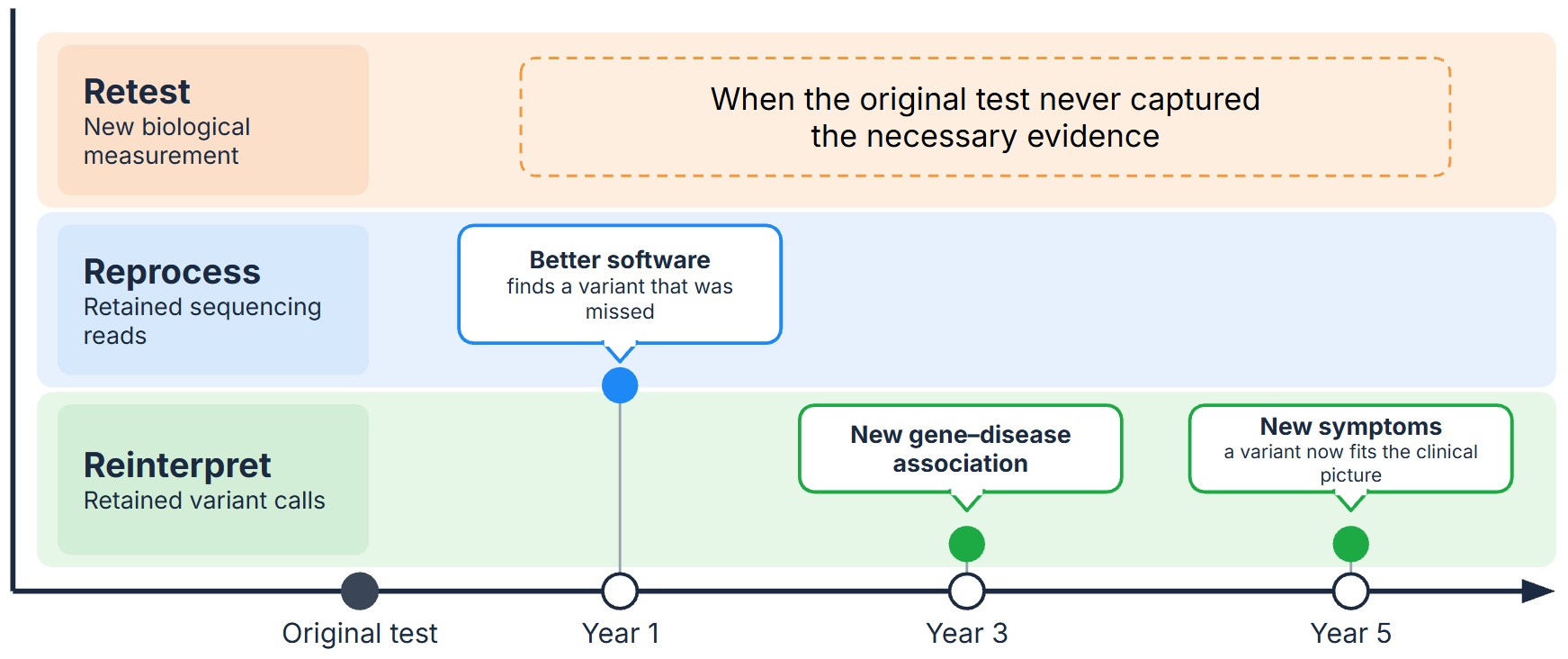
Figure 1: How genomic reanalysis works.
Kept data can give a new answer when one of three things changes:
- Scientific knowledge changes. A variant once classed as harmless or uncertain can be reclassified as disease-causing. Labs record these conclusions in public databases such as ClinVar, so a reanalysis checks earlier findings against each new release.
- Analytical methods improve. Older software can miss large deletions or rearrangements of DNA, or drop real variants through overly strict filters. Better software finds them in the kept data without another test.
- Clinical information develops. A child may develop new symptoms as they grow, and those symptoms change which variants are likely explanations. One commercial coverage policy pays for reanalysis when new symptoms appear.
One Solve-RD case shows what a missed method costs. A girl with seizures and developmental delay had her exome (the protein-coding part of her DNA) sequenced and analysed twice without an answer, because neither analysis looked for missing stretches of DNA. Three tools built to find them were then run on the same data, and all three found a deletion that removes a gene called CSNK2B. The diagnosis took 7 years, which is a lifetime for someone seeking answers.
Systems now repeat this process automatically across thousands of inconclusive tests. One, called Talos, rechecks previously analyzed data against updated scientific evidence and ranks new candidates for expert review. A 2026 study of it revisited data from 4,735 previously undiagnosed people and found 241 diagnoses in 238 of them. Of those, 54% came from new knowledge (32% from new links between genes and diseases, 22% from new evidence about individual variants) and 45% from better filtering and ranking of the same data. Nearly half came from better analysis of data nobody had touched, so a reanalysis system has to run new methods on old data, not only check it against new databases.
The data architecture of reanalysis
An architecture for reanalysis asks four things of the data: keep the right evidence, keep it readable by new software, keep the history of each run, and keep it readable by other labs.
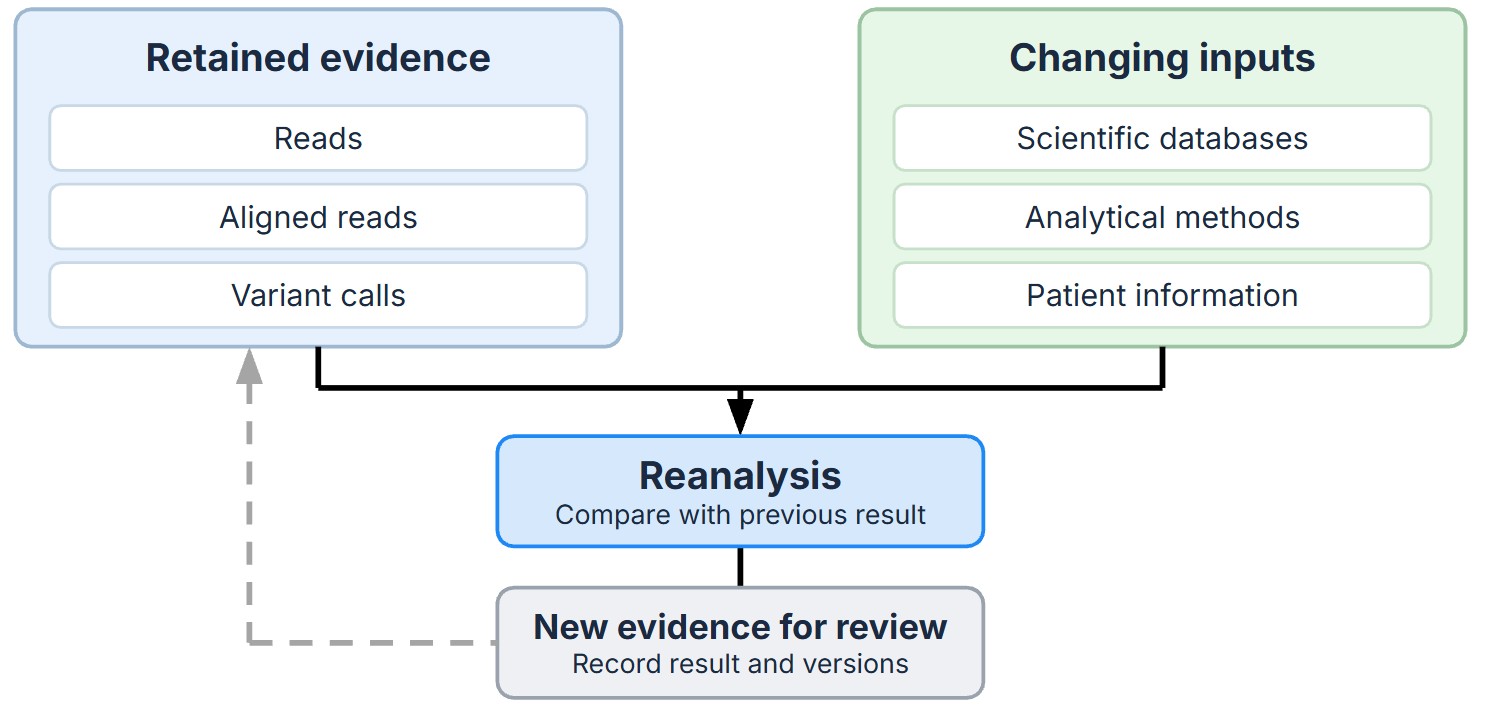
Figure 2: What makes historical data reusable.
Keep the right evidence
Sequencing leaves behind three forms of data, and each keeps a different amount of evidence:
- The original reads. Everything the machine measured.
- The aligned reads. The same reads, placed against the reference genome.
- The variant list. A much smaller record of where the patient differs from the reference.
The girl’s CSNK2B deletion was found by going back to her reads. Her variant list alone could not have shown it.
Keeping all three is a decision each lab makes. CAP, the College of American Pathologists, asks accredited labs to keep sequence and variant files for at least two years but reports on inherited conditions for 20. A lab can keep a negative report for 20 years and delete the evidence that could overturn it after two. Because retained data accumulates year on year, a common pattern is to keep variant calls indefinitely, aligned reads compressed on a cheaper tier, and raw output only for a set window.
Keep it readable by new software
At Radboud University Medical Center, the original exome data for 22 of 85 patients could not be rerun through the lab’s current software when researchers went back to it. Keeping evidence usable is harder than keeping it, because the software, databases and clinical systems around it keep changing, so the data has to stay separate from them:
- A new discovery about a disease-causing gene should not require rebuilding the original sequencing dataset.
- Replacing an analytical tool should not mean losing access to years of historical evidence.
Keep the history of each run
A reanalysis system works in a loop:
- It keeps the variants it has already found.
- It pulls in each new release of databases such as ClinVar.
- It reevaluates the candidates and compares the result with its previous run.
- It sends only findings with new evidence back to an expert.
Talos, for example, compares current annotations, the labels attached to each variant such as how common it is, with prior results and flags what has changed. In the 2026 study, the first reanalysis found 221 of the 241 diagnoses, and 29 monthly cycles found the other 20, on average about a month after the new evidence became public.
That loop depends on each run being recorded. ACMG’s sequencing standards already ask labs to record the version of every pipeline component used for each patient, but they do not explicitly require the same for the databases the variants were checked against, so scientists may know an answer has changed without being able to explain why.
Keep it readable by other labs
Solve-RD pooled data from 6,004 families across 37 centers into one resource that researchers can search by symptom, variant and gene. Evidence that is too thin in one patient can become clear across many, but only if each lab kept its data in a form another lab can read.
The original measurement may be expensive to collect, but it does not have to be a one-time analytical opportunity.
The economics of reanalysis
Reanalysis gets cheaper the less of the original work it has to repeat.
A 2025 UK study of 29 families, each a child and both parents, compared resequencing with reusing archived data. Resequencing and analysis cost £5,021 per family, and retrieving and reanalyzing the archived data cost £2,137. Both found all 41 previously known diagnostic variants, so reuse cost 57% less.
Reinterpreting variants that have already been found costs far less again. The 2026 Talos study put the initial annotation at $11.25 for 1,000genomes,followed by approximately $1.65 a year per 1,000 genomes, in cloud computing alone.
Each promising finding still needs expert review, sometimes more testing, and a clinician to decide whether it explains the patient’s condition and to tell the family. That work is the bottleneck. In a 2024 Australian study, genetic health professionals named workforce capacity as the greatest barrier to reanalysis, and Australian diagnostic laboratories ran more than 25,000 new genomic tests between 2018 and 2021 against 950 reanalyses. Automated reanalysis helps because it sends specialists only the cases where something has changed.
The deletion that explained the girl’s condition was in her original sequencing data, and her search for a diagnosis ended only when a different analytical method was run on it. Whether a lab can ask that question again, and at what cost, depends partly on what it kept when the data was first collected and whether it can still process it.
I enjoy digging into how use cases actually work, from the data and processing to the costs, challenges and tradeoffs. If you have an interesting one you’d like me to explore, reach out on LinkedIn.